

10 Things You Don't Know About Christopher Columbus
The explorer is remembered for “discovering” America, but the truth about Christopher Columbus is more complex — and far less heroic — than the legend that bears his name.

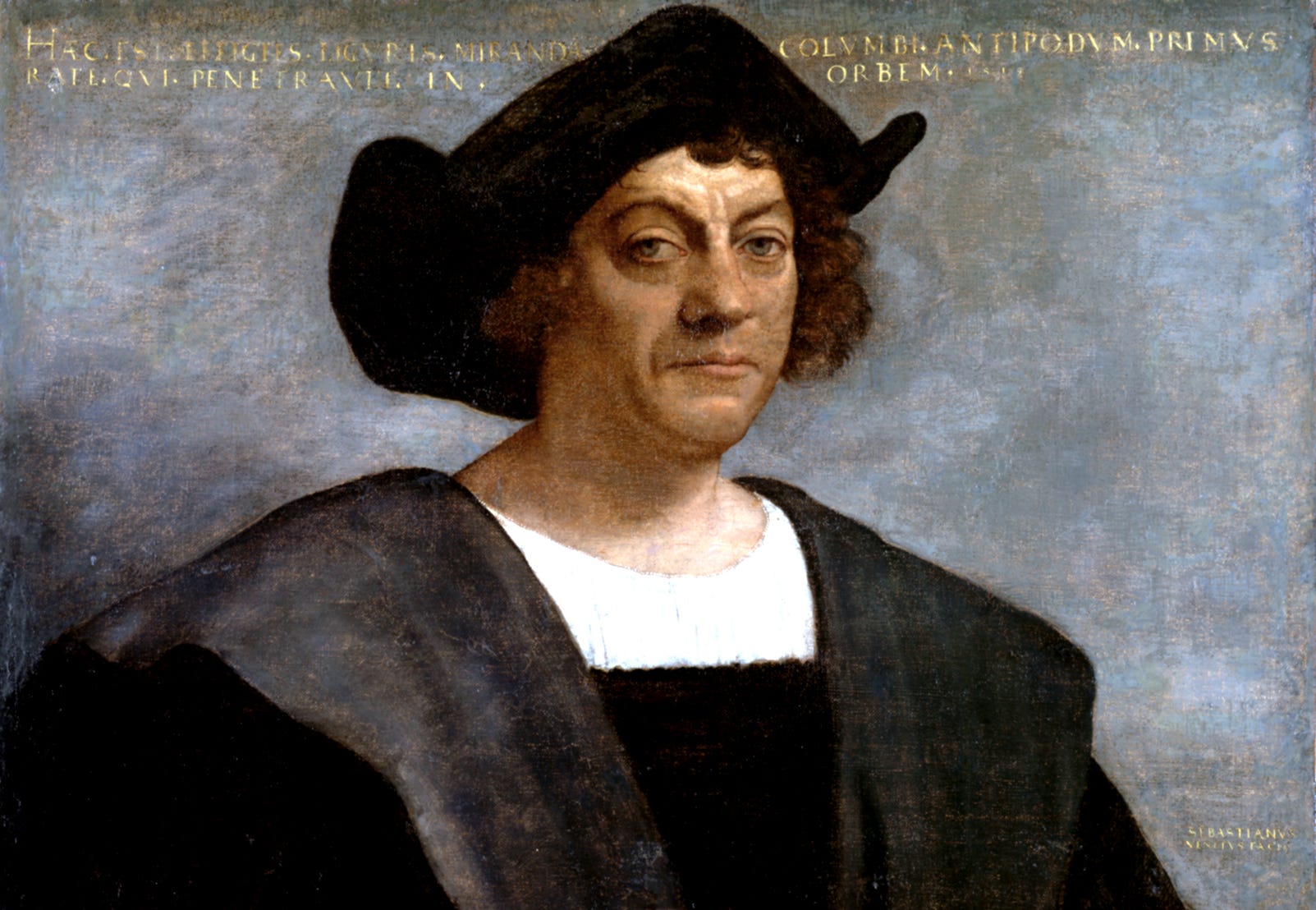
Christopher Columbus remains one of history’s most mythologized figures. For generations, he was celebrated as the daring explorer who “discovered” the Americas, the man whose courage opened the way for a new world. His story became a parable of ambition and perseverance, cemented in schoolbooks, parades, and monuments as the origin point of Western civilization’s expansion across the Atlantic Ocean.
The reality, though, is far more complicated.
Columbus was neither the first European to reach the Americas nor a man guided purely by noble purpose. His voyages were motivated by faith, greed, and political ambition in equal measure, and his actions triggered profound and lasting consequences—among them, the decimation of Indigenous populations and the dawn of European imperialism in the Western Hemisphere.
The “discovery” he’s credited with was, in truth, a collision between worlds that would forever reshape both. Over time, historians have peeled back the layers of myth to reveal a more human, and more troubling, portrait of Columbus: a skilled navigator, a flawed administrator, and a man driven by forces larger than himself.
The facts behind his voyages tell a story of chance, cruelty, and consequence—one that continues to evolve as we better understand the era he helped define. Here are 10 things you don’t know about Christopher Columbus.
10. The “Columbian Exchange” changed the world.
Columbus’s voyages initiated one of the most significant global transformations in human history—the Columbian Exchange. This vast transfer of crops, animals, people, and diseases permanently altered ecosystems and societies on both sides of the Atlantic. Europe gained new staples like corn, potatoes, and tomatoes, while the Americas saw the introduction of horses, cattle, and wheat. Yet the exchange also carried deadly consequences: smallpox and other European diseases decimated Indigenous populations by the millions. The unintended ecological and social upheaval that followed Columbus’s crossings reshaped the trajectory of civilization itself.
9. His legacy was largely forgotten for centuries.
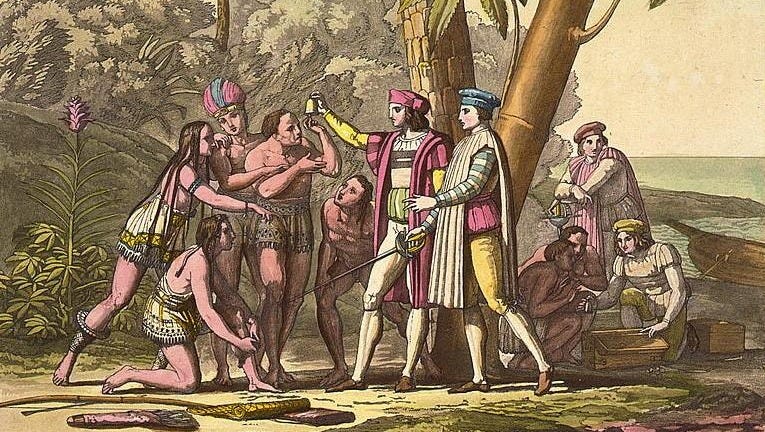
For much of the 16th and 17th centuries, Columbus faded from memory. Other explorers—Magellan, Cortés, and Pizarro—eclipsed him in fame as empires expanded across the globe. It wasn’t until the late 18th century, when newly independent nations sought mythic founders, that his story resurfaced. American leaders, including Thomas Jefferson, elevated Columbus as a symbol of bold exploration and new beginnings. By the late 1800s, he had been reinvented as a near-saintly figure, his name adopted for cities, rivers, and the federal capital—an image built more from patriotic narrative than historical fact.
8. He died convinced he had reached Asia.
Despite multiple voyages and accumulating evidence, Columbus refused to believe he had discovered lands unknown to Europeans. He insisted the islands he encountered were part of the Indies, close to China and Japan. In his later years, he even produced elaborate arguments—based on scripture and classical geography—to prove his claim. When he died in 1506, he remained steadfast in this belief. It was Amerigo Vespucci, not Columbus, who recognized the new lands as a separate continent, and it was Vespucci’s name—not his—that would appear on future maps.
7. He was deeply religious—sometimes to the point of obsession.
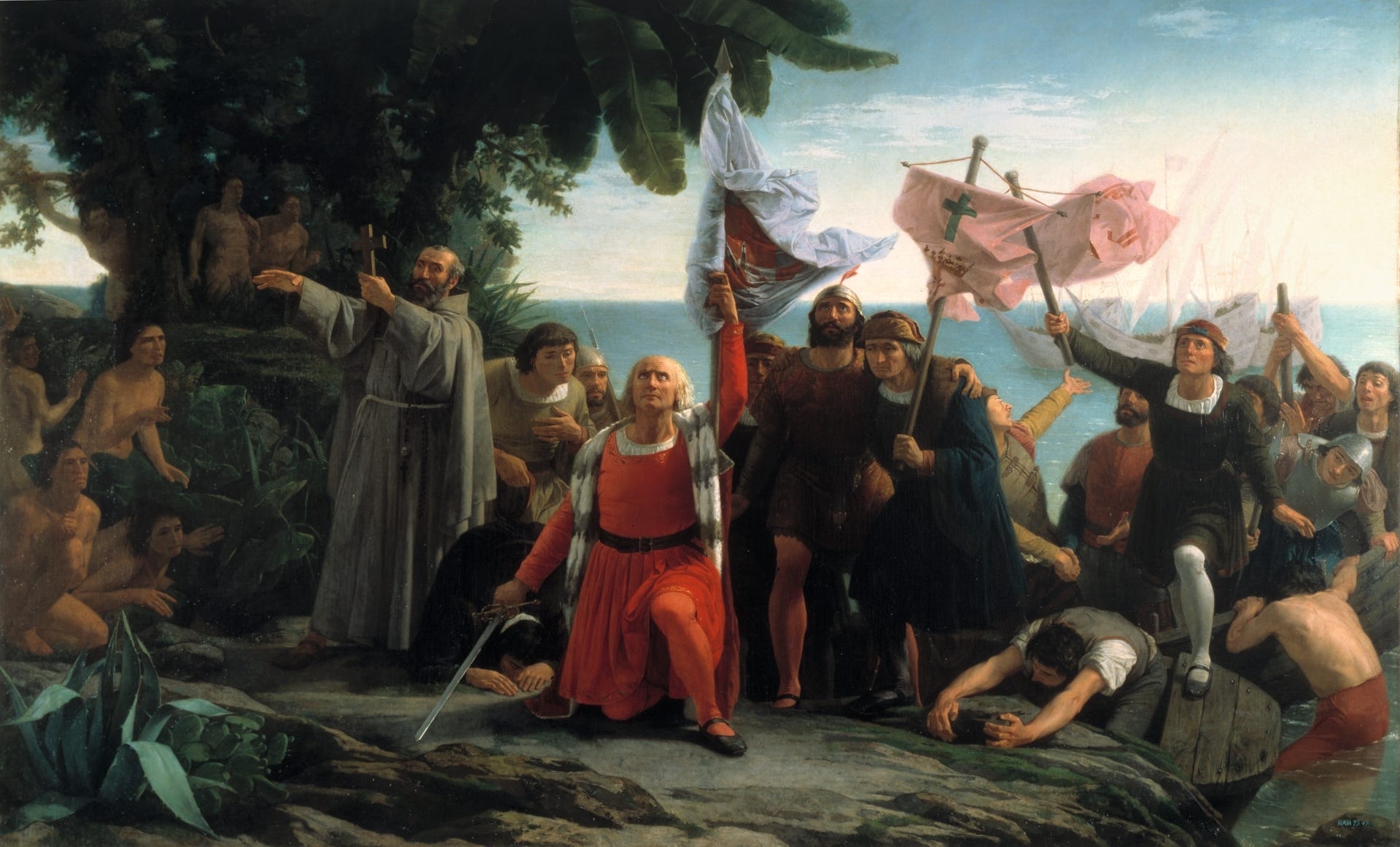
Columbus saw his mission not merely as exploration but as a divine appointment. He believed God had chosen him to bring Christianity to unknown peoples and to gather wealth for a final crusade to reclaim Jerusalem. His letters are filled with biblical references and mystical visions, and in his final years, he became increasingly consumed by apocalyptic prophecy. He believed his discoveries were part of a divine plan signaling the end of the world. Far from the rational man of the Renaissance, Columbus was a medieval thinker sailing into the modern age.
6. He introduced the transatlantic slave trade to the Americas.
Columbus’s voyages opened the first sustained routes for human trafficking across the Atlantic. On his second voyage in 1493, he captured hundreds of Indigenous Taíno people and shipped them to Spain to be sold in Seville’s slave markets. He also established systems of forced labor in the Caribbean colonies, compelling natives to mine gold and harvest crops under brutal conditions. What began as an experiment in colonial control evolved into the vast transatlantic slave trade that would endure for more than three centuries and claim millions of lives.
5. He was arrested and returned to Spain in chains.
By 1500, reports of corruption and cruelty in the colonies reached the Spanish crown. Columbus and his brothers were accused of tyranny, extortion, and violence against both settlers and Indigenous people. The monarchs sent an investigator, Francisco de Bobadilla, who found ample evidence of abuse. Columbus was arrested, stripped of his titles, and sent back to Spain in chains—a humiliating fall for a man once hailed as “Admiral of the Ocean Sea.” Though he was later released and partially restored to favor, his political power was gone, and his final voyage would be one of frustration and failure.
4. He enslaved and brutalized Indigenous people.
Columbus’s colonization of Hispaniola marked the beginning of one of history’s darkest chapters. He imposed a system known as the encomienda, which granted colonists control over native labor in exchange for promises of Christianization. Under this regime, entire communities were destroyed. The Taíno population, estimated at several million before contact, collapsed within decades from disease, violence, and starvation. Columbus himself ordered floggings, executions, and amputations to enforce obedience. His governorship was so brutal that even his contemporaries condemned his actions.
3. His calculations were disastrously wrong.
Columbus’s voyage was based on a monumental miscalculation. Drawing on faulty estimates from ancient scholars, he concluded that Asia lay only a few thousand miles west of Europe. In reality, the true distance was nearly four times greater. Had the American continents not intervened, his ships—the Niña, Pinta, and Santa María—would have run out of supplies long before reaching land. His success owed more to luck than precision, a testament to daring ambition rather than scientific accuracy.
2. Columbus wasn’t Spanish.
Though celebrated as a Spanish hero, Columbus was born in Genoa, in present-day Italy. He spent his early life as a sailor and mapmaker before seeking patronage for his westward voyage. After being rejected by Portugal, England, and France, he finally won support from Spain’s Catholic Monarchs, Ferdinand and Isabella. His allegiance to Spain was pragmatic, not patriotic—he saw royal sponsorship as the only means to achieve his ambitions. Even in his lifetime, his Genoese origins were a point of skepticism and rivalry among European powers.
1. He never actually reached North America.
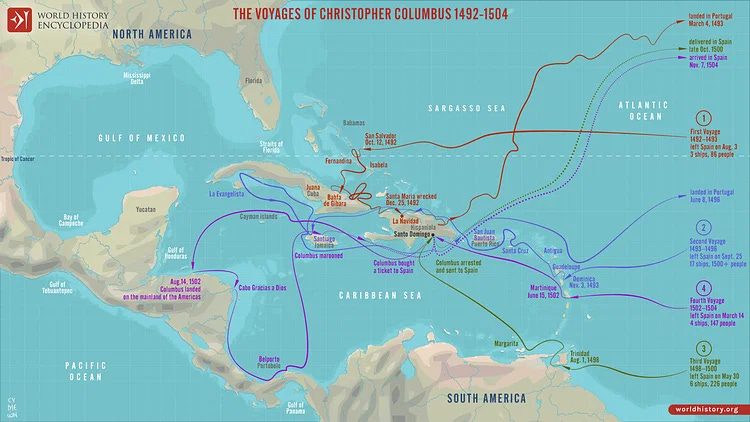
Columbus’s four voyages between 1492 and 1504 took him throughout the Caribbean—exploring the Bahamas, Cuba, Hispaniola, and parts of Central and South America—but he never set foot on what is now the continental United States or Canada. He believed he had reached the edges of Asia, unaware that an entirely separate landmass stood between Europe and the Far East. The first Europeans to reach North America were likely Norse explorers led by Leif Erikson nearly 500 years earlier. Columbus’s achievement, while monumental, was not discovery—it was the beginning of global transformation.
“The 10” is just a fun and lighthearted diversion from the usual analysis and commentary on More Signal, Less Noise. What topics would you like me to explore in The 10? Let me know in the comments.