

Desperately Seeking Antifa
The Trump administration is manufacturing a global Antifa threat to justify domestic crackdowns, silence dissent, and revive the politics of the Red Scare.

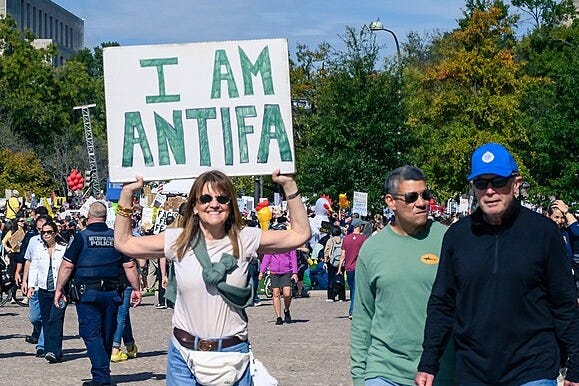
Last year, the Trump administration took the unprecedented step of issuing an executive order designating Antifa a domestic terrorist organization and directing federal agencies to investigate and disrupt political violence and the networks allegedly supporting it.
Now, Secretary of State Marco Rubio and the U.S. counterterrorism apparatus are attempting to rally the world against this supposedly sprawling left-wing threat at a State Department conference in Washington next week.
The problem is that there is no formal, monolithic “Antifa.” No matter how loudly President Donald Trump and his Cabinet rail against the movement, they cannot identify a centralized leadership network, corporate federation, or command hierarchy.
There is a good reason this target remains so elusive: Antifa isn’t an organization. It is a decentralized movement rooted in a shared anti-fascist ideology. It consists of autonomous local activists and loosely affiliated groups that embrace direct action, not a structured entity with officers, membership rolls, or a national chain of command.
That distinction doesn’t matter to an administration desperate for political leverage. It wants a domestic boogeyman capable of convincing the public that terrorists are lurking under every bed, threatening the entire American way of life.
According to published reports, Rubio has invited senior ministers from more than 60 countries to Washington on short notice to discuss what the administration calls the “resurgence of transnational far-left terrorism.” The conference will reportedly focus heavily on violence against political officeholders, despite skepticism among foreign governments and some career counterterrorism officials about the scale and coherence of the supposed threat.
Driven by this fear, the Trump administration is increasingly wrapping itself in an insular security bubble. The administration is considering permanent fencing around Lafayette Square, across from the White House, that would make it easier for authorities to close the historic park during demonstrations or perceived security threats. Several senior administration officials have also moved into military housing, citing concerns about harassment and political violence.
The truth is that political violence is on a frightening upswing as people across the ideological spectrum feel increasingly alienated and marginalized. Some have come to view violence as a viable means of attracting attention to their causes. But the administration routinely cherry-picks which acts of political violence matter.
Trump and his media allies have heavily spotlighted the September 2025 assassination of conservative activist Charlie Kirk, who was shot while speaking at Utah Valley University, using it as evidence of a coordinated left-wing terrorist threat. Tyler James Robinson has been charged with aggravated murder, but the case has not yet gone to trial. A five-day preliminary hearing concluded this week, with final arguments scheduled for September 1, after which a judge will decide whether the case should proceed.
Yet the administration has devoted far less attention to the targeted murders of former Minnesota House Speaker Melissa Hortman and her husband, Mark. The Hortmans were assassinated in June 2025 by Vance Boelter, who disguised himself as a police officer while hunting Democratic state lawmakers. Boelter pleaded guilty last month to federal murder, attempted murder, firearms, and stalking charges. Under the plea agreement, he faces two consecutive life sentences plus 40 years in prison, avoiding a possible federal death sentence.
The federal government has no statutory process comparable to the foreign-terrorist-organization system for formally designating a purely domestic political movement as a terrorist organization. Such a designation also collides with fundamental First Amendment protections for speech and association. The executive order may express the administration’s policy and direct federal enforcement priorities, but it does not create a new domestic-terrorism statute or independently criminalize adherence to an ideology.
To get around those limitations, the administration has pivoted to its foreign-designation powers. The State Department designated four European organizations as Specially Designated Global Terrorists and Foreign Terrorist Organizations: Germany’s Antifa Ost, also known as the Hammer Gang; Italy’s Informal Anarchist Federation/International Revolutionary Front; and Greece’s Armed Proletarian Justice and Revolutionary Class Self-Defense.
By labeling these foreign groups “Antifa threats,” the administration gains access to powerful intelligence, financial, immigration, and prosecutorial tools. Providing material support to a designated foreign terrorist organization is a federal crime. Critics fear the administration could use allegations of ideological, organizational, financial, or digital connections to investigate American activists, nonprofit organizations, and donors that have no operational involvement in terrorism.
Reports about the upcoming Washington conference indicate that foreign allies and some officials within the U.S. counterterrorism establishment are deeply uneasy with this framework. Several governments reportedly question whether far-left terrorism represents the coordinated international threat described by Washington. Some have declined to send senior political representatives, while others appear likely to participate primarily to avoid antagonizing the Trump administration.
The skepticism is understandable. Experts have questioned whether some of the designated European groups remain operationally significant, noting that arrests and police raids have substantially weakened them. Elevating a handful of small, fragmented, or diminished organizations into evidence of a global Antifa conspiracy makes the administration’s case appear more political than analytical.
Critics say the administration is attempting to manufacture global panic over Antifa to justify a broader crackdown on domestic opposition—a classic page from the authoritarian playbook. While Trump and his acolytes complain about conservative voices being silenced around the world, they have few qualms about using the regulatory and investigative power of the federal government to intimidate liberal opposition at home.
The critics are likely right. The Trump administration is a maximalist power structure that treats dissent as an obstacle to be suppressed rather than a legitimate feature of democracy. Elevating the “Antifa threat” is a coordinated effort to frighten the public, rally the conservative base, and distract attention from the administration’s policy weaknesses. Trump has paired this rhetoric with warnings about a resurgent communist threat while invoking “Great Replacement” themes to inflame anti-immigrant sentiment.
It is a strategy taken straight from the Joe McCarthy Red Scare playbook—which makes sense, given that Trump’s early mentor was McCarthy’s infamous chief counsel, Roy Cohn.
Trump and his allies desperately want an organized, monolithic Antifa to exist on the same structural level as the Proud Boys, Oath Keepers, or Patriot Front. They need a tangible, hierarchical enemy to justify police crackdowns, financial surveillance, aggressive prosecutions, and the deployment of troops into American streets.
Unfortunately for them, Antifa remains an amorphous movement organized around an idea.
And an idea is much harder to kill than an organization.