

Hegseth Disingenuously Declares Timeout on War Powers
The administration argues a ceasefire resets the War Powers timeline, setting a precedent that could weaken congressional authority over future conflicts.

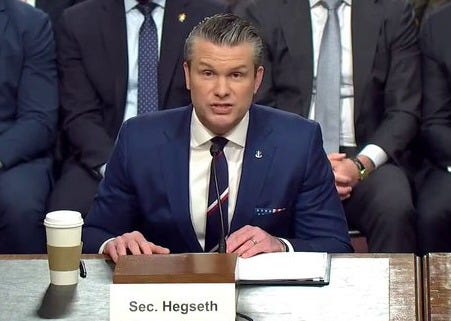
The war on Iran should be over today. The Trump administration did not seek congressional approval for the conflict within 60 days of the onset of hostilities, as required by the War Powers Act. Congress has failed to pass any resolution supporting or authorizing the war. Under the law, the U.S. should pack up its tents, weigh anchor, and return home.
Yet that’s not what’s going to happen because Defense Secretary Pete Hegseth has determined that the war is technically over under the ongoing ceasefire, thereby nullifying the War Powers Act deadline.
This is not a novel argument. It’s purely disingenuous.
The U.S. is currently engaged in hostilities with Iran since President Donald Trump ordered the war on February 28, joining Israel in initiating a massive assault on the Middle Eastern country. For the past three weeks, the U.S. and Iran have been locked in an uneasy truce, giving themselves breathing room for peace negotiations. In the meantime, Iran has closed the Strait of Hormuz to most commercial traffic, and the U.S. is blockading all Iranian shipping. Trump has even ordered the destruction of any Iranian boat caught laying mines in shipping lanes.
None of that sounds like the war has ended. But let’s go with Hegseth’s assertion for a moment to test its logic.
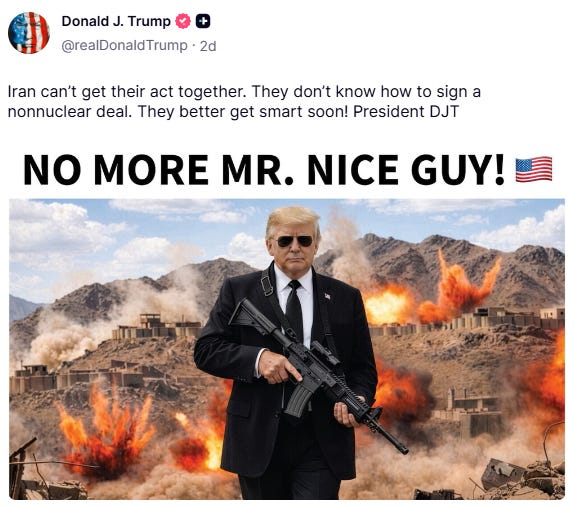
By Hegseth’s reckoning, if the U.S. resumes bombing Iran, as Trump threatened through a meme of himself walking across the desert wearing sunglasses and carrying an M4 assault rifle, it would mark the start of a whole new conflict since the time-out ended the last one. In that reasoning, we had Iran War 1.0, the current ceasefire is Iran War 1.5, and the next conflict will be 2.0.
This logic also means that North and South Korea are at peace rather than in a state of war. Since the 1953 armistice, the two sides have stood off against each other in an uneasy peace. Every day, someone dies in the Korean Demilitarized Zone due to minor infractions and the responses of trigger-happy border guards. The DMZ is one of the most heavily armed regions in the world and often erupts in violence that, if unchecked, could lead to all-out war.
Let’s bring the logic closer to home. I’m a lifelong New England Patriots fan, even in the bad years (Go Pats!). By Hegseth’s logic, the Patriots lost Super Bowl 51.1 to the Atlanta Falcons, which led at halftime 21–3. Because the halftime whistle is like ending the game, the resumption in the third quarter would be a whole new game. In that scenario, the Patriots defeated the Falcons not 34–28 (the greatest comeback in Super Bowl history), but 31–7 (the scoring for the second half).
Let’s face facts: The U.S. isn’t extracting itself easily from the Iran conflict it started. The Iranians have little incentive to capitulate to American pressure. And Iran knows the U.S. is highly unlikely to escalate to nuclear weapons or put boots on the ground. So, we’re in a stalemate that leaves the Persian Gulf situation pretty much where it was when the war started, except for the disruption to shipping. The global economic disruption is putting more pressure on the U.S. than on Iran.
Even with Democratic opposition, Democrats are unlikely to pull troops out of the field or leave the situation as is. Rather, if a bill comes to a vote, they’ll impose parameters that restrict, but do not curtail, military operations. These restrictions are why previous votes on the War Powers Act have failed: the Trump administration and Republicans don’t want guardrails.
Hegseth is deceptively claiming the ceasefire amounts to a reset, nullifying the application of the War Powers Act, because the Trump White House doesn’t want congressional approval, oversight, or restrictions. They want to act unilaterally and with impunity, without giving the appearance of ignoring or violating the law.
This is not about semantics—it is about authority. Redefining a war as “over” because the shooting has paused is a convenient fiction that strips the War Powers Act of meaning. If that standard holds, any administration can wage war, pause, and reset the clock at will. That is not a loophole. It is the erosion of the law itself.
So Trump will continue to roar in his bellicose language and tweets. Hegseth will continue to skate on the edge of credulity like an Olympic figure skater. Congress will continue to limp through the Trump era, defanged and impotent. And the Iran war will go on, as Trump said, for as long as it takes.
NOTE: I refer to Pete Hegseth as Secretary of Defense, as that is his legal title. While President Trump authorized him to use the title Secretary of War and rebrand the military as the Department of War, Congress has not yet passed legislation to formalize the change.