

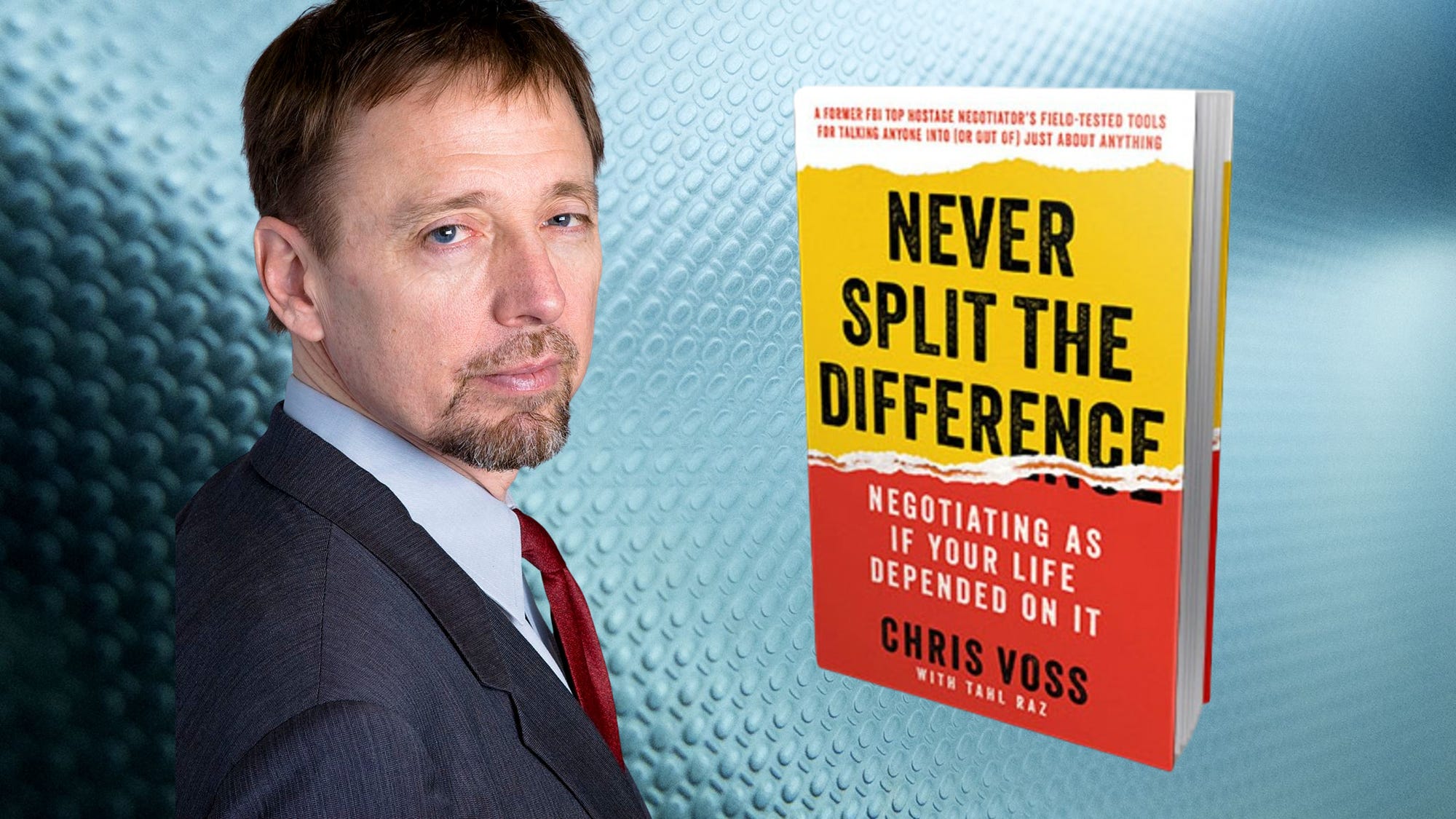
Never Split the Difference: Negotiating Beyond Compromise
Former FBI negotiator Chris Voss argues that compromise isn’t the goal. His book shows how empathy and unconventional tactics can lead to stronger outcomes.

They say there’s nothing like being there in person. People want to interact with people. And if you understand how to read people, you can interact with them better. For many, negotiation is thought to be about compromise—meeting in the middle to resolve differences.
Chris Voss, a former FBI hostage negotiator, rejects that premise. In Never Split the Difference, he argues that compromise is often the least effective outcome. Instead, he demonstrates that reading people, managing emotions, and strategically guiding conversations yield better results than splitting the difference ever could.
Voss draws from a career spent in high-stakes environments where lives depended on communication. Hostage negotiations, by nature, allow no room for splitting the difference. You cannot agree to release half the hostages in exchange for half the ransom. Success in those scenarios required deep psychological insight, patience, and the ability to make the other side feel heard while maintaining control of the negotiation.
The book’s strength lies in its ability to translate lessons from crisis environments into everyday professional and personal settings. Voss illustrates how the same tactics used against armed hostage-takers can work in boardrooms, salary negotiations, or even family disputes.
At the heart of Never Split the Difference is the concept of tactical empathy—the ability to identify, acknowledge, and influence another person’s emotions. Voss underscores that negotiation is not about logic but about emotions driving decisions.
Techniques like labeling (“It seems like you’re frustrated”) and mirroring (repeating a counterpart’s words) are simple but powerful ways to make the other side feel understood. Another important tool is the use of calibrated questions—open-ended queries such as “How can we solve this problem?” or “What about this is important to you?” These questions shift responsibility to the counterpart while providing valuable information to the negotiator.
Perhaps most counterintuitive is Voss’s emphasis on “no” as a starting point rather than a rejection. Whereas most negotiators fear hearing “no,” Voss shows how it creates safety for the other side and opens the door to genuine dialogue. By reframing “no,” negotiators gain a platform for more productive conversations.
One of the most practical contributions of the book is the Ackerman bargaining method, a structured approach to setting targets, making incremental offers, and using psychological cues to move a counterpart toward agreement. The technique shows how preparation and patience outperform impulsive concessions.
Voss also highlights the importance of silence. In negotiations, silence often feels uncomfortable, but leaving space compels the other party to fill the void—usually revealing their true motivations. The book also draws attention to the nonverbal side of negotiation. Borrowing from research such as the 7-38-55 rule (words convey 7 percent of meaning, tone conveys 38 percent, and body language 55 percent), Voss reinforces the idea that how something is said often matters more than what is said.
Unlike classical negotiation frameworks, such as Harvard’s "Getting to Yes," which emphasize rational problem-solving and compromise, Voss’s methods are grounded in psychology and human behavior. He does not focus on finding a midpoint but on creating leverage by making the other side feel safe, understood, and willing to reveal their true position. This departure from traditional approaches explains why the book feels both unconventional and disruptive in the field of negotiation.
What sets Never Split the Difference apart from other negotiation guides is its grounding in real-world experience under extreme pressure. Voss’s anecdotes, from dealing with kidnappers in the Philippines to working with terrorists in the United States, provide both drama and credibility. These stories engage the reader while illustrating the universal nature of his methods.
Another strength is the accessibility of the techniques. Many negotiation books are academic, filled with abstract theories or rigid frameworks. Voss instead offers practical, memorable tools—such as mirroring, labeling, and calibrated questions—that readers can apply immediately. The combination of vivid storytelling and actionable tactics makes the material resonate. Beyond individual readers, Voss’s influence has extended into corporate training, sales organizations, and leadership development programs. Many companies now integrate his tactics into negotiation workshops, a testament to their perceived practicality and effectiveness.
Never Split the Difference is not without its limitations. Voss sometimes overstates the universality of his methods, implying that all negotiations can be handled like hostage crises. While many of the techniques are widely applicable, there are situations where compromise remains the most efficient or necessary resolution.
Voss’s style can also lean toward anecdotal repetition. His points are clear, but the frequent reliance on FBI stories may give the impression that the lessons are best suited for high-stakes confrontations rather than everyday negotiations. Readers seeking a systematic framework may find the narrative structure less disciplined than that in other business texts. Still, these limitations do little to undermine the book's core value. Its greatest achievement is reframing how people think about negotiation—not as a battle of logic or a contest of compromise, but as a fundamentally human interaction shaped by emotion, perception, and subtle influence.
While the work is ostensibly about negotiation, its lessons extend far beyond the realm of deal-making. At its core, Never Split the Difference is about communication—how to listen better, build trust faster, and influence outcomes without force. These skills are applicable in leadership, management, sales, parenting, and personal relationships. Voss argues that life is a series of negotiations.
Whether persuading a client, calming a child, or working out terms with a contractor, the ability to understand and shape conversations is a decisive advantage. Since its publication in 2016, "Never Split the Difference" has remained a bestseller in business categories, underscoring the enduring influence of its author. Its combination of practical advice, engaging anecdotes, and psychological insight continues to resonate with readers nearly a decade later.
Never Split the Difference offers several valuable tools for success in challenging negotiations. While the techniques may at times appear unconventional or even uncompromising, Voss demonstrates through his experience that they produce results. The open question is whether those results are always replicable in every context, or if some situations still demand the traditional give-and-take of compromise.
I’m on a mission to read 50 books in 2025. This is the 48th book in my journey. What books are you reading? What books should I read? Share your thoughts in the comments or message me. All thoughts and suggestions are welcomed.