

The Problem With Flying Isn’t Pajamas
As delays mount and terminals decay, Washington’s response to a collapsing air system is to scold travelers for how they dress.

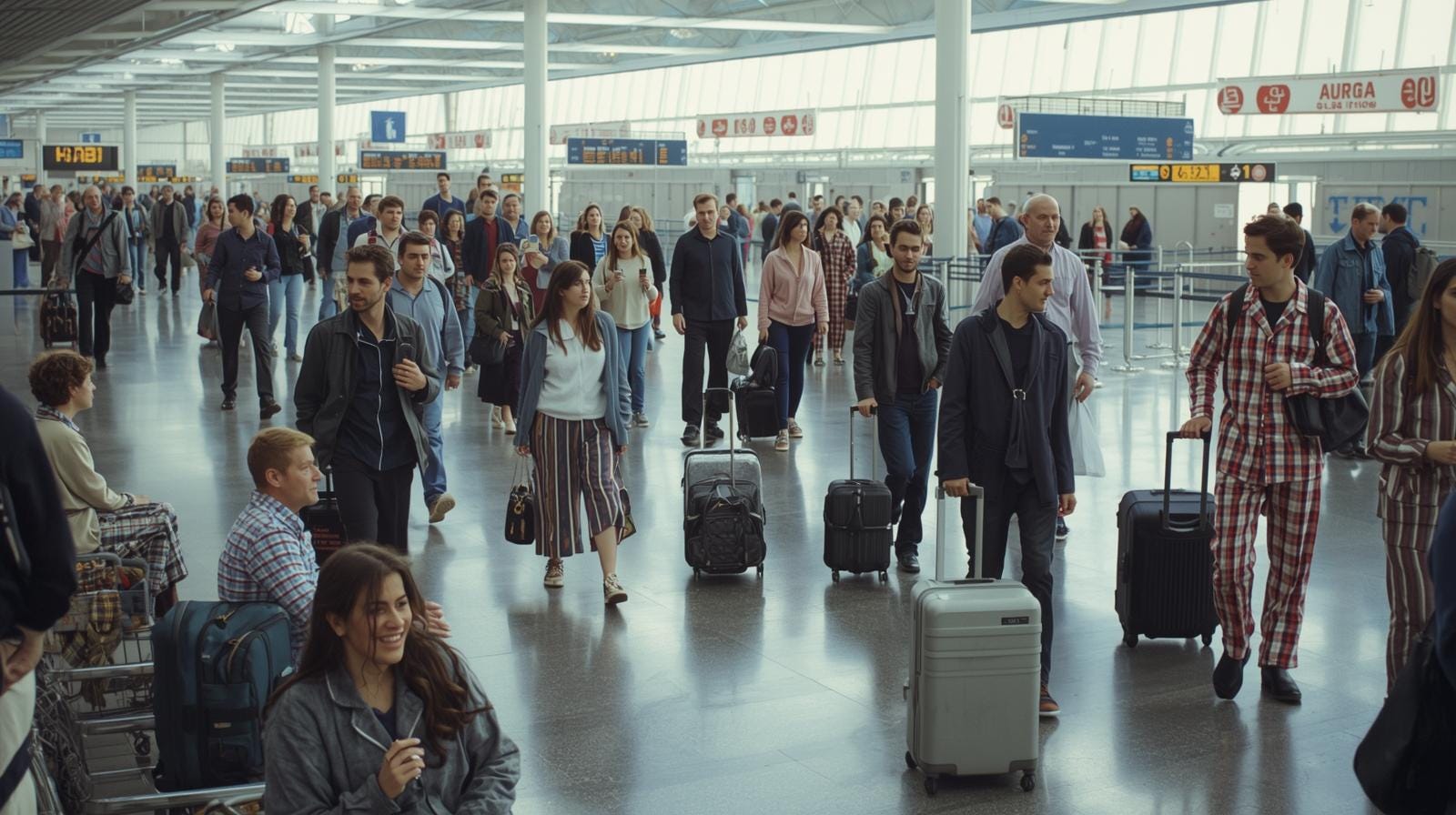
Transportation Secretary Sean Duffy has acknowledged that the air transportation system is broken. Long and inconvenient security lines. Crowded airports. Countless flight delays. Packed planes. Overtaxed air traffic control centers. Rising costs. A system under visible strain.
Duffy’s simple and eloquent solution: Dress better.
It is a telling prescription. When government officials respond to structural failure with a call for better manners, they are really offering distraction—a shift from institutional responsibility to individual behavior. Duffy told the American public that they are flying like slobs and should take more pride in their appearance when taking to the friendly skies. It is a quaint notion. And, not surprisingly, people are roundly rejecting it.
Let’s jump back in time. The year was 1987. I was a young soldier in Germany, planning my first visit home after a year at my first duty station. I went to the local travel agency and bought a round-trip ticket out of Frankfurt. I borrowed a large leather steamer suitcase from a friend — enough clothes and belongings to last me 30 days stateside. I arranged for a ride to the airport.
The problem: I had no experience flying. Before joining the Army, I had flown only twice with my mother, when I was still a toddler. Flying was for the wealthy — not for us peasant class. Even when I flew to basic training in Oklahoma, most of the arrangements and logistics were handled by the Army. This was my first time venturing into an airport solo.
As a kid, I grew up on a steady diet of movies and television shows from the 1950s and 1960s — the so-called Golden Age of entertainment. In those depictions, people who flew donned suits and dresses as if it were a formal occasion. Advertisements from the era showed people dining in comfortable seats aboard finely appointed planes. It all seemed glamorous.
I remember one episode of Good Times, the show about a poor Black family in Chicago from the late 1970s, in which one of the characters is wearing his best suit. Someone asked, “Are you going to a funeral or the airport?” Impressionable as I was, my takeaway was that even people without money were expected to dress up for travel.
In the late 1970s, my father took shifts driving an airport limousine to help make ends meet. I rode shotgun on runs to Boston’s Logan Airport. Each trip felt like an event. The airport was a modern wonder to a young kid like me. And the people he drove were adventurers traveling to far-off places. While many didn’t wear suits, those who did were often well dressed.
That was my frame of reference. So I grabbed the one civilian blazer I owned, ironed a shirt and slacks, but forwent the tie. I was off to the airport dressed as best I could. My buddies thought I looked ridiculous — and I probably did.
Each year now, I fly between 125,000 and 175,000 miles. I spend about half my time on the road for work, shuttling between airports, hotels, convention centers, and client offices. Every trip is an endurance exercise. People struggle through security. People don’t understand boarding processes. People fight over snacks. People drink at all hours. And, of course, there are the various states of dress.
Business travelers on short hops will still wear office attire if they are in a hurry. But most people now dress for comfort. And it is not hard to understand why. Planes are uncomfortable, crowded, and increasingly squalid. Even the seats in business class can feel punishing. In premium and economy, space is scarce. The mood runs from closed-off to outright hostile. Aircraft are among the few places where people willingly cram together like cargo. Fliers take comfort where they can find it, and most often that comfort comes in what they wear.
Over the years, I have seen it all. Pajamas. Hunting jackets. Shorts and flip-flops. Sweatsuits. Crop tops. Formal gowns. Endless sports logos. Mickey Mouse hats with ears. Clothes so tight they look shrink-wrapped. The airport has become a parade of personal expression — and personal indifference.
On a flight home from Austin a few years ago, I was sitting in 1C on a 6:30 a.m. departure to New York. The seat next to me filled at the last minute. A tiny young woman slipped in wearing a cropped T-shirt that exposed her midriff and short-shorts that left little to the imagination. My first and only thought was not judgment but concern: Dear God, she’s going to be cold. She turned out to be Jamie Lynn Spears, Britney Spears's younger sister — gracious, personable, and easy to talk to.
The truly revolting moments come not from clothing but from behavior — most notably when people wander the cabin in socks or bare feet. It happens more often than most passengers realize. That is why the public reaction was so swift and visceral to a video of Robert Kennedy Jr., the secretary of Health and Human Services, using the restroom on a flight in bare feet. The offense was not aesthetic. It was hygienic.
The conditions passengers now endure are not accidental. They are the product of decades of airline deregulation and industry consolidation that prioritized financial efficiency over service resilience. Since the Airline Deregulation Act of 1978, carriers have steadily shed excess capacity to maximize load factors and shareholder returns. That left little margin for weather, mechanical issues, staffing shortfalls, or air traffic control disruptions. At the same time, mergers reduced meaningful competition while shrinking consumer leverage. The modern air travel experience did not decay because passengers abandoned decorum; it deteriorated because regulators permitted a business model that treats disruption as an acceptable operating cost.
So when Duffy says people should dress better when flying, he is not entirely wrong. A little more personal decorum would improve the airport experience at the margins. But marginal gains in civility will not repair structural failure. Americans have the right to dress — within reason — as they choose. Airlines already reserve the authority to deny boarding for attire deemed offensive. Beyond that, whether someone boards in a blazer or in sweatpants is a matter of personal liberty, not public policy.
What is troubling is not the comment itself, but what it reveals about the Department of Transportation's priorities. Air travel in the United States is failing at the systemic level: aging infrastructure, chronic staffing shortages, fragile scheduling models, weak consumer protections, and a regulatory regime that consistently favors airline balance sheets over passenger rights. Scolding travelers over attire does nothing to address any of that.
If the department is serious about improving air travel, its focus should be institutional rather than cosmetic. Make security more efficient. Restore and enforce the Air Travelers’ Bill of Rights so airlines are accountable for delays and cancellations. Require airlines to maintain basic cleanliness throughout a flight — restrooms become indefensible within minutes of takeoff. Mandate more humane seat spacing so passengers are not packed in as revenue units rather than human beings. These are policy levers. These are solvable problems.
Telling Americans not to wear pajamas to the airport is not reform. It is deflection. And, predictably, the result is that more people will wear pajamas to the airport — not out of sloth, but out of quiet defiance. When a cabinet secretary blames sweatpants for a broken transportation system, it is not fashion that has failed — it is governance.