

Time’s Running Out for Comey
With the statute of limitations set to expire, Trump’s Justice Department is pushing to indict the former FBI director—transforming long-promised retribution into official policy.

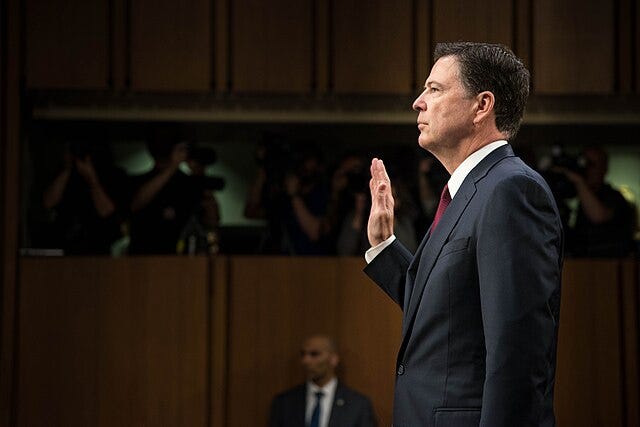
UPDATE: On Thursday evening, the Justice Department indicted former FBI Director James Comey for lying to Congress, despite the previous prosecutor on the case declining to prosecute due to a lack of evidence.
The Justice Department under President Donald Trump is moving to prosecute political enemies. What was once a campaign slogan has become official policy: punish opponents and dissuade dissent. The case of former FBI director James Comey illustrates how far this retribution has advanced.
Comey is expected to face charges for allegedly lying to Congress, a federal offense. According to reports, prosecutors are racing against the statute of limitations, which expires Tuesday. The allegation stems from 2020 testimony in which Comey said he did not authorize a leak to the press about a renewed investigation into Hillary Clinton’s use of a private email server while secretary of state. That disclosure, made days before the 2016 election, may have influenced its outcome.
Why pursue Comey now? Because he represents everything Trump resents about the Justice Department—independence, impartiality, and unwillingness to bend to presidential will.
Comey, a Republican and career FBI officer, was appointed in 2013 by President Barack Obama. He cultivated a reputation for professionalism and fairness, often to the frustration of politicians on both sides. His loyalty was to the law and to the best interest of the nation.
Trump entered office assuming the Justice Department was an instrument of presidential power. He was dismayed to find an institution that prized independence, and he never forgave his first attorney general, Jeff Sessions, for recusing himself from the Russia investigation. To Trump, that was betrayal. Of Comey, he demanded personal loyalty. But Comey refused to “bend the knee” or subordinate the law to presidential politics. Trump eventually fired him, and ever since, Comey has been in his crosshairs.
Today, back in office and surrounded by loyalists, Trump is seeking to finish the job. Earlier this week, he urged Attorney General Pam Bondi to pursue Comey, along with New York Attorney General Letitia James—who secured Trump’s conviction for business fraud—and California Senator Adam Schiff, who led Trump’s first impeachment. “We can’t delay any longer… JUSTICE MUST BE SERVED, NOW!!!” Trump posted on Truth Social, naming his targets.
The calls came after Erik S. Siebert, U.S. attorney for the Eastern District of Virginia, resigned under pressure. According to multiple accounts, Siebert had investigated Comey and James but declined prosecution, citing lack of evidence. His exit cleared the way for the retribution campaign.
The push against Comey is not isolated. Reports surfaced that the Justice Department sent letters to individuals involved in past politically sensitive cases, including FBI agent William Aldenberg, who responded to the Sandy Hook school shooting. DOJ sought information about whether he had financially benefited from litigation against conspiracy theorist Alex Jones. The request was later withdrawn amid criticism, but observers said such tactics were designed to harass, drain resources, and send a warning: remain silent, or risk becoming a target.
Trump and his allies have long decried the “weaponization” of justice. They cite his indictments in New York and Georgia, federal cases over classified documents, and the prosecutions of more than 1,500 participants in the Jan. 6, 2021, attack on the Capitol as proof of political bias. Yet it is Trump who is now turning the Justice Department into a tool of political vengeance.
The irony is not lost. The chant of “Lock Her Up” against Hillary Clinton, once the soundtrack of Trump rallies, foreshadowed the present moment. Clinton’s use of a private email server was ruled improper but not illegal. That did not matter. Trump relished the energy of the crowd demanding jail time for a political opponent. The stage was set.
Now in power again, Trump is not merely chanting. He is acting. For his supporters, jailing a few enemies would fulfill promises left unmet. For his critics, it is the realization of a feared authoritarian impulse—punish opposition, reward loyalty, and blur the line between law and politics.
This time, justice is not about the law—it is about loyalty.